L
Lisa TongVerified review
A very positive experience
The referral form was emailed to me immediately, I walked into a collection centre the next morning and my results arrived the very next day. It made me feel they genuinely cared.
DUTCH stands for Dried Urine Test for Comprehensive Hormones. It maps how your hormones are made, converted and cleared across a full day: oestrogens, androgens, progesterone, cortisol and melatonin, their metabolites, and the endocrine disruptors that can interfere with them.
How it works ↓Everything included. Kit, prepaid return, LC-MS/MS and ICP-MS laboratory analysis of 70+ markers and your full 10-page report.
Trusted by 2,000+ Australians
How it works
Order online, collect four dried urine samples across one day at home and post them back. No needles, no clinic, no appointment.

Get your at-home hormone test kit in minutes. No appointment or referral needed to order a kit from us.

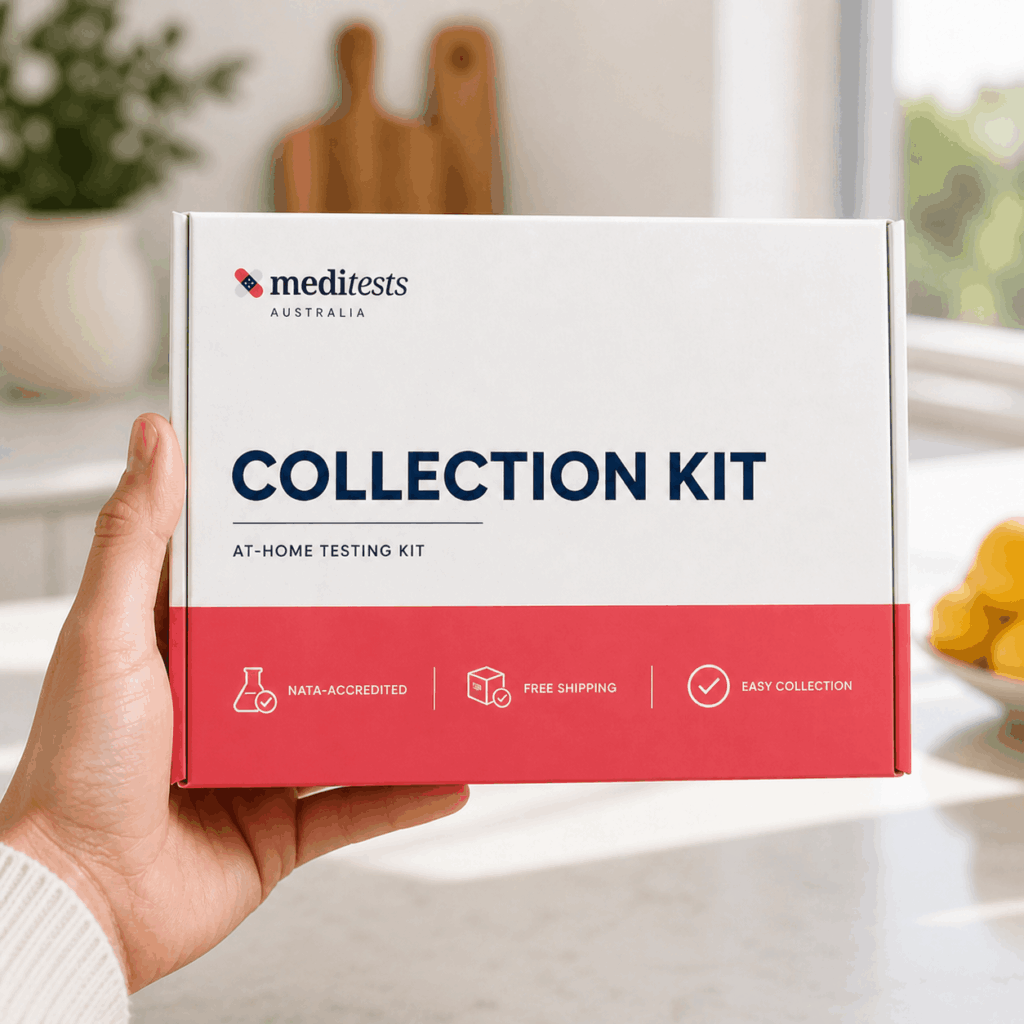
Delivered in plain packaging within 1 to 3 business days, with filter paper strips, instructions and prepaid return included. Morning, midday, afternoon and evening, a few seconds each on the strip, let them dry, and post the lot back.

Your full report is delivered to your secure portal once the laboratory has completed analysis, with every marker against a reference range, a hormone cascade chart, and written commentary on each pathway.



Hormones are not static numbers. They are made, converted into other hormones, used, and broken down along pathways that differ from person to person. A DUTCH test maps that whole system from dried urine. Here is what it actually tells you.
Oestrogens, progesterone, androgens, cortisol and cortisone curves, melatonin, eleven endocrine disruptors and ten organic acids, in one comprehensive dried urine panel. The full picture of how your hormones are made, converted and cleared, not a single level at a single moment.
Not just oestradiol, oestrone and oestriol, but the 2-OH, 4-OH and 16-OH metabolites of phase 1 and the methylated 2-MeOH and 4-MeOH forms of phase 2, with the ratios between them. Shows which pathway your body favours and how efficiently it clears what it makes.
Morning, midday, afternoon and evening samples give your daily stress hormone pattern rather than one reading. Plus metabolised cortisol (THF and THE), the 11β-HSD index that shows how cortisol is being activated and cleared, and a four-point melatonin curve.
Testosterone, DHT, DHEA, DHEA-S, androstenedione and the 5α-reductase activity ratio. Pregnanediol, allopregnanolone and five more progesterone metabolites. How your body converts and uses these hormones, not just how much is circulating.
BPA, PFAS with PFOA and PFOS, mercury, lead, arsenic, cadmium, aluminium, chromium and nickel. Environmental chemicals that can interfere with hormone signalling, measured alongside the hormones themselves so exposure and effect sit on one report.
Four samples on filter paper across one day, dried at home, posted back in the prepaid mailer. No needles, no clinic, no appointment. Your kit arrives in plain, unbranded packaging.
The DUTCH test (EndoMAP) measures seventy-three markers from four dried urine samples by LC-MS/MS and ICP-MS, grouped by pathway, so you see each level against its reference range and how the parts of the system relate to each other.
Seventeen markers covering the three parent oestrogens, their phase 1 hydroxylated metabolites, their phase 2 methylated metabolites, and the ratios that show which pathways your body favours.
The most potent oestrogen and the primary one in cycling women.
The main oestrogen after menopause, and a reservoir that converts to and from oestradiol.
The weakest of the three, dominant in pregnancy and often read as a marker of balance.
The proportion of the milder oestriol relative to the two stronger oestrogens.
A phase 1 metabolite on the 2-hydroxylation pathway, generally regarded as the more favourable route.
The oestrone form of the 2-hydroxylation pathway.
A phase 1 metabolite on the 4-hydroxylation pathway, the route that benefits most from efficient phase 2 clearance.
The oestrone form of the 4-hydroxylation pathway.
The third phase 1 route, a more oestrogenically active metabolite.
The balance between the 2 and 16 pathways, a widely used indicator of oestrogen metabolism pattern.
The methylated, phase 2 form of 2-OH oestradiol, showing it has been processed for clearance.
The methylated form of 2-OH oestrone.
The methylated form of 4-OH oestradiol. Efficient methylation here is what neutralises the 4-OH pathway.
The methylated form of 4-OH oestrone.
How efficiently the 2-pathway is being methylated, a read on phase 2 capacity.
How efficiently 4-OH oestradiol is being methylated and cleared.
How efficiently 4-OH oestrone is being methylated and cleared.
Ten markers covering the androgen cascade from DHEA through to testosterone and DHT, with the conversion ratio that shows which direction your body is pushing them.
The adrenal precursor at the top of the androgen cascade, from which testosterone and oestrogens are built.
The sulphated, longer-lived form of DHEA, reflecting overall adrenal androgen output.
The intermediate between DHEA and testosterone, also a precursor to oestrone.
A downstream metabolite on the 5α pathway; read against etiocholanolone for reductase activity.
The 5β counterpart to androsterone. The pair together show how androgens are being broken down.
The principal androgen in both men and women, measured here alongside its metabolites rather than alone.
A naturally occurring isomer of testosterone. The testosterone to epi-testosterone ratio is a check on production versus external sources.
The more potent androgen testosterone converts into, relevant to skin, hair and prostate tissue.
A metabolite of DHT that reflects overall 5α-reductase activity in tissue.
The androsterone to etiocholanolone ratio, showing whether your body preferentially converts testosterone towards the more potent DHT.
Eight markers that show not only progesterone status but how it is being converted, including the neurosteroid pathway.
The main urinary metabolite of progesterone and the standard marker for progesterone production.
A neurosteroid metabolite of progesterone that acts on GABA receptors in the brain.
A further metabolite on the allopregnanolone pathway.
An intermediate on the pathway from progesterone to allopregnanolone.
A metabolite on the alternative, less active progesterone pathway.
A mineralocorticoid precursor made from progesterone, linked to fluid and blood pressure regulation.
A glucocorticoid produced from deoxycorticosterone, a secondary stress hormone.
The balance between progesterone and oestrogen, one of the most requested ratios in hormone testing.
Seventeen markers: free cortisol and free cortisone at four time points across the day, the metabolised forms that show total output, the 11β-HSD index, and a four-point melatonin curve.
Your waking cortisol, which should be the highest point of the day.
Cortisol as it begins to fall from the morning peak.
The mid-afternoon level, where a healthy curve continues to decline.
Cortisol before bed, which should be the lowest point of the day.
The inactive form cortisol converts into, measured at the same four points to show how much is being deactivated.
Cortisone at midday.
Cortisone in the afternoon.
Cortisone in the evening.
Pooled cortisol across the day, a measure of overall output.
Pooled cortisone across the day.
The main metabolised form of cortisol, reflecting how much cortisol your body actually produced.
The main metabolised form of cortisone.
Total glucocorticoid production, which can differ from free cortisol when clearance is fast or slow.
The balance of the enzyme that activates cortisone into cortisol and back again, showing whether you favour the active or inactive form.
Melatonin at waking, which should be low.
Melatonin at midday.
Melatonin as it rises towards night, a read on your sleep-wake rhythm alongside the cortisol curve.
Eleven environmental chemicals and metals that can interfere with hormone signalling, measured from the same sample by ICP-MS so exposure sits on the same report as effect.
Found in some plastics, can linings and thermal receipts. Structurally similar enough to oestrogen to bind its receptors.
The broad class of persistent chemicals used in non-stick, water-resistant and stain-resistant products.
A specific PFAS compound, one of the most studied.
Another specific PFAS compound, historically used in firefighting foams and coatings.
Large predatory fish, dental amalgam and some occupations. Interferes with thyroid and other hormone systems.
Old paint, older plumbing and some imported goods. Accumulates and affects multiple hormone pathways.
Contaminated water, rice and some seafood. A known endocrine disruptor at chronic exposure.
Tobacco smoke, some shellfish and industrial exposure. Accumulates with a long half-life.
Cookware, antiperspirants and some processed foods.
Industrial exposure and some supplements, measured here as a potential disruptor rather than a nutrient.
Jewellery, stainless steel and some foods. A common sensitiser.
Ten organic acids covering nutritional status, neurotransmitter metabolism and oxidative stress, adding a layer of context around the hormone results.
A marker of vitamin B6 status; rises when B6 is insufficient for tryptophan metabolism.
A marker of biotin status.
A sensitive functional marker of vitamin B12 status.
The main metabolite of dopamine, reflecting dopamine turnover.
The main metabolite of adrenaline and noradrenaline, reflecting stress hormone turnover.
A tryptophan metabolite on the kynurenine pathway, associated with inflammation and neuroprotection.
Another kynurenine pathway metabolite, associated with inflammation and oxidative stress.
A marker of oxidative damage to DNA.
A marker of glutathione status and turnover.
A tryptophan metabolite produced by gut bacteria, a read on microbial tryptophan metabolism.
Marker descriptions are general explanations to help you read your report, not a diagnosis. Hormone metabolite testing reflects your production, conversion and clearance at the time of sampling and is interpreted alongside your history, cycle, medications and symptoms.
Everything the DUTCH test covers, at a glance.
Compare
A blood test answers how much of a hormone is circulating right now. A DUTCH test answers a different set of questions: how it is being made, converted, used and cleared, across a whole day.
All 73 markers are reported against reference ranges, and the steroid hormones are drawn onto a cascade chart so you can see the pathways, not just a list. Cortisol, cortisone and melatonin are plotted as daily curves.
The laboratory adds a plain-language interpretation for oestrogens, progesterone, androgens, cortisol and melatonin, explaining what the pattern in your results can indicate and what is worth looking at next.
The full 10-page report is delivered to your secure portal. Keep it, retest later against the same ranges, or hand it to your GP, gynaecologist, naturopath or integrative doctor to guide next steps.
Hundreds of Australians have taken control of their health with MediTests.
The referral form was emailed to me immediately, I walked into a collection centre the next morning and my results arrived the very next day. It made me feel they genuinely cared.
Ordered the test, got the referral letter within 20 minutes. Got the test done on a Saturday and had the results by Sunday evening. Seriously efficient and very quick.
I ordered the tests I wanted online, then dropped into the clinic for the blood draw during my lunch break. By lunchtime the following day my results had been emailed to me.
Absolutely loved that I got to choose what tests I wanted. The process was very simple and my results arrived very quickly. I would definitely use again and recommend to friends and family.
It was easy to choose and purchase the test I needed at a reasonable price and set up the appointment online for the next day. The results were delivered electronically within a day or two.
Easy checkout of the test on the website, easy to get the test done and results came quickly. Good to get an idea of any issues as a prep before seeing the GP.
I got my results back within a few hours, a lot quicker than I was expecting. There were plenty of locations I could go to for my sample. Highly recommend.
A reliable method to get a test done without the doctor's prescription. The whole thing was easy to organise and I would happily use it again.
Very efficient and convenient from start to finish. Exactly the kind of easy, no-fuss service I was hoping for.
The ease of the whole experience, and the quick turnaround with results. Exactly what I was after.
Everything you need, in a single order.
Seventy-three markers from four at-home dried urine samples, covering oestrogen, androgen, progesterone and cortisol metabolism, melatonin, endocrine disruptors and organic acids, with your full 10-page laboratory report. Analysed in Australia.
Filter paper for four collections, posted in plain packaging
Included in the box, nothing to pay
At a NATA-accredited Australian laboratory
Your steroid pathways drawn, not just listed
For every hormone pathway on the report
Order online, no appointment
DUTCH stands for Dried Urine Test for Comprehensive Hormones. Instead of a single blood draw, you collect four dried urine samples across one day at home, and the laboratory measures not only your parent hormones but the metabolites they are broken down into. That shows how your hormones are being made, converted and cleared, and how cortisol, cortisone and melatonin rise and fall across the day. Our DUTCH test is the EndoMAP panel from NutriPath, a NATA-accredited Australian laboratory.
Seventy-three markers from four samples: 17 oestrogens including the phase 1 and phase 2 metabolites and their ratios, 10 androgens including testosterone, DHT, DHEA and the 5α-reductase ratio, 8 progesterone metabolites, free cortisol and free cortisone at four time points, metabolised cortisol and the 11β-HSD index, a four-point melatonin curve, 11 endocrine disruptors including BPA, PFAS and heavy metals, and 10 organic acid markers.
Anyone who wants a detailed picture of their hormone metabolism rather than a single level. That includes people on or considering hormone therapy who want to see how they are metabolising it, people tracking their stress hormone pattern across the day, people interested in how their body processes oestrogen, and anyone who has had blood hormone results that did not explain what they were experiencing. It is suitable for both women and men.
The DUTCH Test (EndoMAP) is $429.00. That single price covers the at-home collection kit, prepaid return postage, LC-MS/MS and ICP-MS laboratory analysis of all 73 markers, and your full 10-page report. There is no referral fee and no clinic visit to pay for.
Yes. Your samples are posted in the prepaid mailer to NutriPath, a NATA-accredited laboratory in Australia. Nothing is sent overseas, and your results are read against the laboratory's own reference ranges.
You collect four dried urine samples across one day at home: morning, midday, afternoon and evening. Each is a few seconds on a filter paper strip, which you then let dry. The kit includes step-by-step instructions and a prepaid return mailer. There are no needles and no clinic visit. If you have a menstrual cycle, the instructions explain which days to collect on so your results are read against the right reference ranges.
Your full report is delivered to your secure portal once the laboratory has completed analysis. You can read it yourself or share it with your GP, gynaecologist, naturopath or integrative doctor to guide next steps.
A blood test measures how much of a hormone is circulating at the moment the blood is drawn, and typically covers a handful of parent hormones. A DUTCH test measures the metabolites as well, which shows how your body is converting and clearing each hormone, and it samples four times across the day so cortisol, cortisone and melatonin are read as curves rather than single points. It also includes endocrine disruptors and organic acids that a blood hormone panel does not. The two are complementary and are often used together.
Yes. The androgen section covers testosterone, DHT, DHEA and the 5α-reductase conversion ratio in detail, and the cortisol, melatonin, oestrogen metabolism, endocrine disruptor and organic acid sections apply equally. Results are read against sex-specific reference ranges.
No. It is a self-requested at-home test kit that you order online without a referral or appointment.
No. A DUTCH test reflects your hormone production, conversion and clearance at the time of sampling and is not a standalone diagnostic tool. Results are interpreted alongside your history, cycle, medications and symptoms, and anything that needs follow up should be taken to your GP or practitioner.

A DUTCH test from home: four dried urine samples across one day, 73 markers, and a map of how your hormones are made, converted and cleared.
Get my test kit →MediTests is a private, self-requested pathology service. The sample is self-collected at home and analysed by a specialist Australian laboratory. Hormone metabolite testing reflects production, conversion and clearance at the time of sampling and is not a standalone diagnostic tool for any condition. Results are intended to support, not replace, the advice of your treating doctor, and may lead to further investigation. ABN 70 686 814 951.
Unlock coupon
Get 10% off your first blood test
Get updates on our new blood panels and join the community.
Please enter a valid email address.
Unlock coupon
Get 10% off your first at-home test kit
Collected at home, posted back, results to your inbox. No clinic visit needed.
Please enter a valid email address.