
What Is a DUTCH Test and What Does It Cost in Australia?
A DUTCH test measures hormones and their breakdown products from dried urine samples you collect at home across one day. Here is what it measures, how it works and who it suits.
- A DUTCH test measures hormones and their breakdown products from dried urine samples collected across one day.
- Four samples show a pattern across the day, including cortisol and melatonin, rather than a single moment.
- The MediTests DUTCH Test (EndoMAP) measures 73 markers in six groups, collected at home with no GP referral needed.
- It is different from a blood hormone test, which gives a snapshot at one point in time. Neither is better in every case.
- A DUTCH test is a way to measure and track hormone patterns, not a diagnosis.
So, what is a DUTCH test?
DUTCH stands for Dried Urine Test for Comprehensive Hormones. It measures hormones and their metabolites from urine you dry on filter paper at home, with samples collected at four points across one day.
A metabolite is what your body makes as it breaks a hormone down. Measuring metabolites as well as the hormone itself adds detail that a single hormone level cannot show, such as which pathway the hormone is being processed along.
In Australia the test is also sold as EndoMAP. The MediTests DUTCH Test (EndoMAP) is a home kit analysed by NutriPath, a NATA-accredited Australian laboratory.
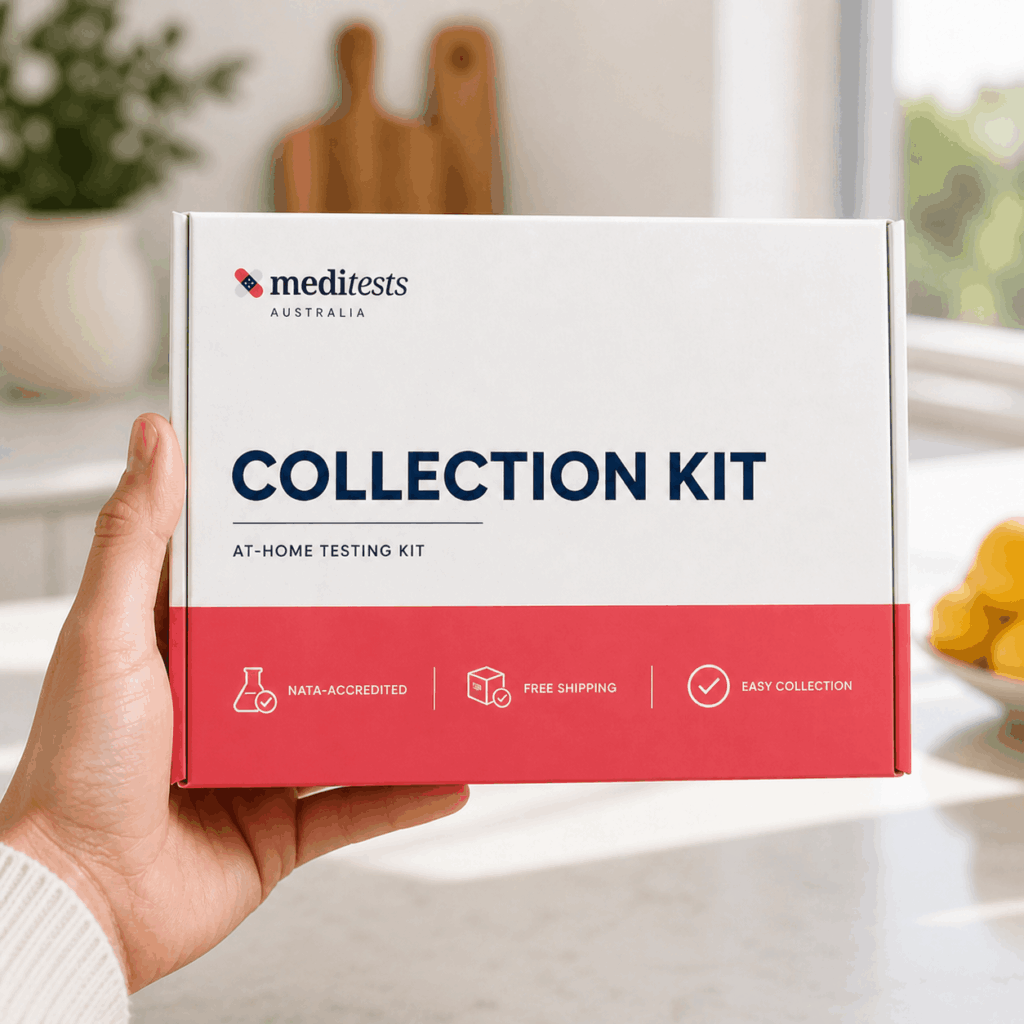
Everything arrives in one kit. Filter paper strips, simple instructions and a prepaid return mailer, in plain packaging.
You collect four samples across one normal day at home, let them dry, and post the kit back. No appointment, no clinic, no referral.
What does a DUTCH test measure?
The MediTests DUTCH Test (EndoMAP) measures 73 markers from four dried urine samples. They sit in six groups, listed here from the product page.
| Group | Markers | What it shows |
|---|---|---|
| Oestrogens and metabolites | 17 | Oestrogen levels and which pathways they are processed along |
| Androgens | 10 | Testosterone, DHEA and how actively testosterone converts to DHT |
| Progesterone metabolites | 8 | Progesterone activity and its balance against oestrogen |
| Cortisol, cortisone and melatonin | 17 | Your daily cortisol rhythm, total cortisol output and melatonin across the day |
| Endocrine disruptors | 11 | Chemicals and metals that can interact with hormone systems |
| Organic acids | 10 | Markers linked to B vitamin status, neurotransmitter breakdown and oxidative stress |
See all 73 markers by name
| Group | Every marker measured | What it shows |
|---|---|---|
| Oestrogens and metabolites (17) | Oestradiol (E2), oestrone (E1), oestriol (E3), the oestrogen quotient, 2-OH, 4-OH and 16-OH metabolites, 2-MeOH and 4-MeOH metabolites, and their ratios | Oestrogen levels and which pathways they are processed along |
| Androgens (10) | DHEA, DHEA-S, androstenedione, androsterone, etiocholanolone, testosterone, epi-testosterone, DHT, 5α-androstanediol, 5α-reductase activity | Androgen levels and how actively testosterone is converted to DHT |
| Progesterone metabolites (8) | Pregnanediol, allopregnanolone, allopregnanediol, 3α- and 20α-dihydroprogesterone, deoxycorticosterone, corticosterone, pregnanediol / oestradiol ratio | Progesterone activity and its balance against oestrogen |
| Cortisol, cortisone and melatonin (17) | Free cortisol and free cortisone at four points in the day, total cortisol and cortisone, THF, THE, metabolised cortisol, 11β-HSD index, melatonin | Your daily cortisol rhythm, how much cortisol you make overall, and melatonin across the day |
| Endocrine disruptors (11) | BPA, PFAS, PFOA, PFOS, mercury, lead, arsenic, cadmium, aluminium, chromium, nickel | Levels of chemicals and metals that can interact with hormone systems |
| Organic acids (10) | Xanthurenic acid, β-hydroxyisovaleric acid, MMA, HVA, VMA, kynurenic acid, quinolinic acid, 8-OH-deoxyguanosine, pyroglutamic acid, indoleacetic acid | Markers linked to B vitamin status, neurotransmitter breakdown and oxidative stress |
Because the four samples are spread across one day, the report shows a pattern for cortisol and melatonin, not a single reading. That pattern is the main thing a single blood draw cannot give you.
Four collection points across one day. A single blood test gives you one of these dots.
How does a DUTCH test work at home?
There is no clinic visit and no GP referral needed. Collection takes place across a single day.

What is in the kit: filter paper strips, instructions and a prepaid return label.
You can preview a full sample report before you buy, so you know exactly what the result will look like.
How is a DUTCH test different from a blood hormone test?
Both measure hormones, but they look at them differently. A blood test is usually a single sample taken at one moment. A DUTCH test collects four samples across a day and adds the metabolites.
| DUTCH test | Blood hormone test | |
|---|---|---|
| Sample | Dried urine on filter paper | Blood |
| Number of collections | Four across one day | Usually one |
| What is measured | Hormones and their metabolites, with a daily pattern for cortisol and melatonin | Hormone levels at the time of collection |
| Where it is collected | At home | At a collection centre, no appointment needed |
| Best for | Patterns, pathways and a wide set of markers in one kit | A direct snapshot of specific hormone levels |
Neither is better in every situation. MediTests also offers a full range of hormone blood tests, and a saliva option, the Female 28-Day Hormone Profile, which tracks oestradiol and progesterone across a whole cycle.
Why do people get a DUTCH test?
Most people get one because they want a clearer view of their hormones, not because of a single event. These are the situations that come up most.
- Wanting a baseline. A starting point across many hormones at once, to compare against later.
- Looking at cortisol across a day. Four samples show how cortisol sits from morning to evening, which one reading cannot.
- Seeing the metabolites, not just the hormone. Useful when a blood test has shown a level but not how it is being processed.
- Tracking changes over time. A repeat test shows how markers have moved as circumstances change, including through the menopause transition.
- Preparing information for a health professional. Bringing a report to a GP or practitioner so the conversation starts with measured results.
Ready to see your hormone pattern?
Get the DUTCH TestHow do you read and use the results?

Your report lists each marker, your result and the laboratory's reference range, with anything outside the range flagged. It shows what was measured, not what caused it, so it works best as one piece of a bigger picture. Three steps make it useful:
- Go group by group. Start with the flagged results, then the daily cortisol and melatonin pattern, then the groups that matter most to you. A marker inside its range is useful information too.
- Take it to a health professional. Your GP or practitioner can read it alongside your health history and any medicines you take.
- Repeat the same test to compare. Same kit, same laboratory, samples collected at the same four points in the day. Keep a short note of what changed between tests. Your GP can help you decide on timing.
What does a DUTCH test cost in Australia?
The current price is always on the DUTCH Test (EndoMAP) product page, so you see an up-to-date figure rather than one that may have changed since this guide was written.
If you are comparing providers, compare what each price includes, not just the number:
- How many markers are measured. The MediTests kit measures 73.
- How many samples are collected. Four dried urine samples across one day.
- Where it is analysed. A NATA-accredited Australian laboratory.
- Whether you can preview a report. A full sample report is on the product page.
- Whether a referral or appointment is required. With MediTests there is neither, so there is no separate consult fee to factor in.
Is a DUTCH test right for you?
The right test depends on the question you are asking.
- A DUTCH test suits you if you want many hormones and their metabolites in one kit, with a cortisol pattern across the day, collected at home.
- A blood hormone test suits you if you want a snapshot of specific hormone levels from a sample taken at a collection centre, usually with faster results. See the hormone blood tests range.
- A cycle-mapping saliva test suits you if the question is how oestradiol and progesterone move across a menstrual cycle. That is the Female 28-Day Hormone Profile.
- Talking to your GP first suits you if you are not sure which test fits, or you have a specific health question in mind.
What are the limitations?
A DUTCH test does not diagnose menopause or any other condition. The Australasian Menopause Society says menopause is diagnosed on symptoms and history, and describes FSH, AMH and oestradiol levels as "unnecessary tests in diagnosing menopause for most women" (Australasian Menopause Society). Professor Susan Davis AO makes the same point about perimenopause (Monash Lens, October 2025). Both are about blood tests, and the same logic applies to any hormone test.
Dried urine hormone testing is newer than blood testing and has a smaller evidence base. A 2019 peer-reviewed study found that dried urine results showed substantial agreement with serum results and that four spot samples agreed closely with a 24-hour urine collection (BMC Chemistry), though that study was authored by the developer of the original DUTCH test. Treat your report as information to discuss with a GP or another health professional.
Tests mentioned in this article
DUTCH Test (EndoMAP)
73 hormone, metabolite, cortisol, melatonin, endocrine disruptor and organic acid markers from four dried urine samples collected at home.
Female 28-Day Hormone Profile
Oestradiol and progesterone measured at 11 points across one cycle, plus testosterone, from at-home saliva samples.
Hormone blood tests
Male and female hormone profiles, advanced health and hormone checks and thyroid profiles, collected at any of 3,300+ centres with no appointment.
See every at-home option on our at-home test kits page.
Frequently asked questions
DUTCH stands for Dried Urine Test for Comprehensive Hormones. It measures hormones and their breakdown products from four dried urine samples collected across one day. The MediTests DUTCH Test (EndoMAP) is collected at home.
The MediTests DUTCH Test (EndoMAP) measures 73 markers from four dried urine samples, across oestrogens and their metabolites, androgens, progesterone metabolites, cortisol, cortisone and melatonin, endocrine disruptors and organic acids.
You collect four dried urine samples at home across one day: morning, midday, afternoon and evening. Each takes a few seconds on a filter paper strip, which you leave to dry before posting everything back in the prepaid mailer.
The current price is shown on the DUTCH Test (EndoMAP) product page. The figure there is all-inclusive, with no referral or appointment fee on top.
EndoMAP is the name the test is sold under in Australia, and it is also known as a DUTCH test. The MediTests DUTCH Test (EndoMAP) is the same dried urine hormone test either way.
You can get the MediTests DUTCH Test (EndoMAP) without a GP referral or appointment. Choose the test, pay, and the kit is posted to you in plain packaging.
A DUTCH test measures and tracks hormone patterns and does not diagnose menopause or any other condition. Menopause is diagnosed on symptoms and history, and a GP or other health professional is the right person to talk through your results.
- Australasian Menopause Society. Diagnosing menopause (information sheet, January 2016). menopause.org.au
- Davis S. I'm a woman approaching middle age, do I need to get my hormones checked? Monash Lens, 28 October 2025. lens.monash.edu
- Newman M, Pratt SM, Curran DA, Stanczyk FZ. Evaluating urinary estrogen and progesterone metabolites using dried filter paper samples and gas chromatography with tandem mass spectrometry (GC-MS/MS). BMC Chemistry 2019;13:20. doi.org
Reviewed by the MediTests Medical Team. This article is general information, not personalised medical advice. Always discuss your results with a doctor.
See your hormone pattern across a day
73 markers from four dried urine samples you collect at home. No GP referral needed.
Get the DUTCH Test