
Perimenopause and Hormone Testing: What a Hormone Test Can and Can't Tell You
Your 40s are when hormones start moving, and most women have never seen theirs on paper. Here is what a hormone test shows you, the one thing it does not, and how to get a clear picture from home.
- A hormone test shows you where your oestrogen, progesterone, testosterone, cortisol and melatonin actually sit, and how they move across a day.
- It will not tell you whether you are in perimenopause. That is a conversation about your periods and symptoms with your GP. What it gives you is the numbers to bring to it.
- Hormones swing from day to day in your 40s, which is exactly why a pattern across a day beats one reading.
- The MediTests DUTCH Test (EndoMAP) measures 73 markers from four dried urine samples you collect at home. No GP referral, no appointment.
- A first test is a baseline. Repeat it later and you can see what has changed, not just how you feel.
What is going on with your hormones in your 40s?
Perimenopause is the stretch from when your periods start changing, or menopausal symptoms begin, to a year after your final period. Jean Hailes says it usually starts at around 47 and lasts four to six years on average, and that the average age of menopause in Australia is 51 (Jean Hailes, Australasian Menopause Society).
During those years oestrogen and progesterone do not fall in a neat line. They rise and dip, sometimes from one day to the next. That is why a single reading can be hard to read on its own, and why seeing a pattern, and a baseline you can come back to, is so much more useful.
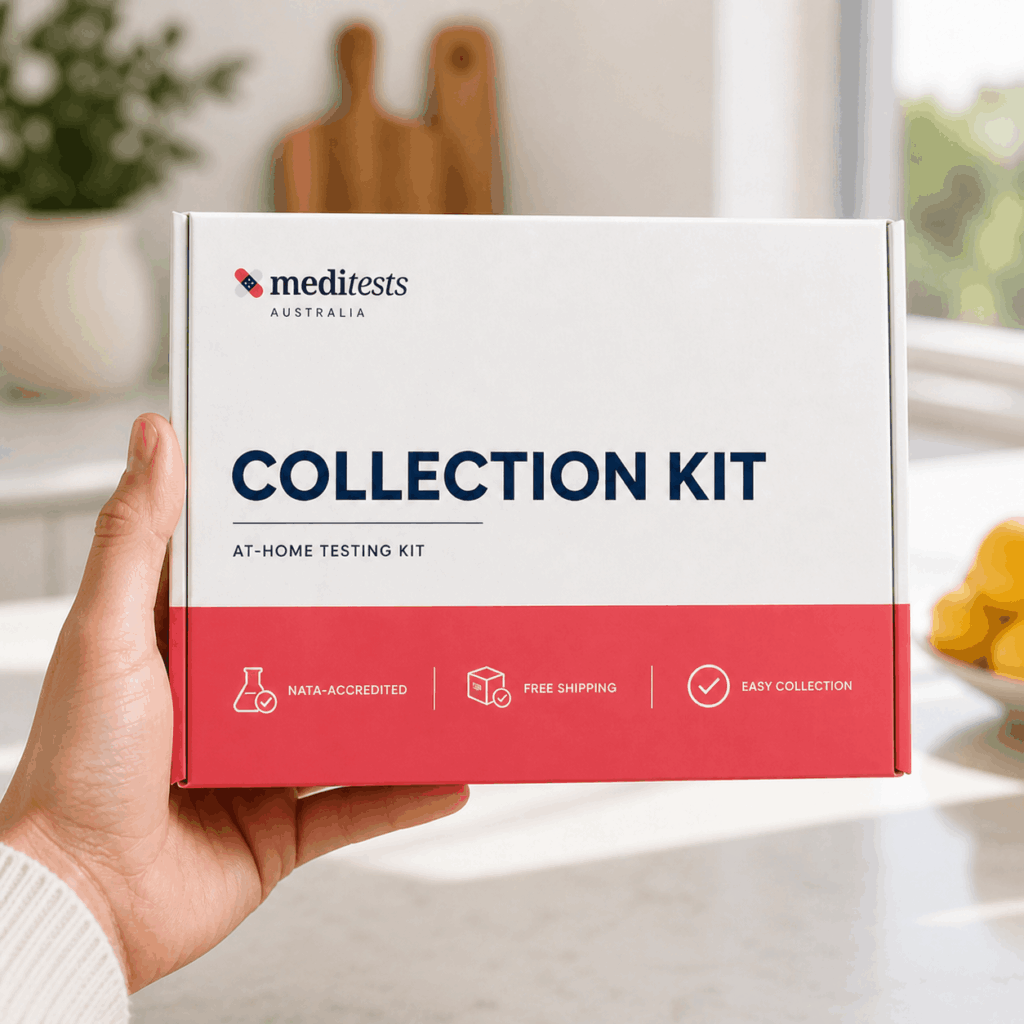
Everything arrives in one kit. Filter paper strips, simple instructions and a prepaid return mailer, in plain packaging.
You collect four samples across one normal day at home, let them dry and post the kit back. No appointment, no clinic, no referral.
What can a hormone test tell you?
A lot more than most women expect. The DUTCH Test (EndoMAP) measures 73 markers from four dried urine samples, in six groups.
| Group | Markers | What it shows you |
|---|---|---|
| Oestrogens and metabolites | 17 | Where your oestrogen sits and which pathways your body is using to process it |
| Progesterone metabolites | 8 | Progesterone activity and how it balances against oestrogen |
| Androgens | 10 | Testosterone and DHEA, the hormones behind energy, drive and muscle |
| Cortisol, cortisone and melatonin | 17 | Your stress hormone rhythm from morning to night, and your sleep hormone |
| Endocrine disruptors | 11 | Chemicals and metals, such as BPA, PFAS, mercury and lead, that can interact with hormones |
| Organic acids | 10 | Markers linked to B vitamin status, neurotransmitter breakdown and oxidative stress |
See all 73 markers by name
| Group | Every marker measured | What it shows |
|---|---|---|
| Oestrogens and metabolites (17) | Oestradiol (E2), oestrone (E1), oestriol (E3), the oestrogen quotient, 2-OH, 4-OH and 16-OH metabolites, 2-MeOH and 4-MeOH metabolites, and their ratios | Oestrogen levels and which pathways they are processed along |
| Androgens (10) | DHEA, DHEA-S, androstenedione, androsterone, etiocholanolone, testosterone, epi-testosterone, DHT, 5α-androstanediol, 5α-reductase activity | Androgen levels and how actively testosterone is converted to DHT |
| Progesterone metabolites (8) | Pregnanediol, allopregnanolone, allopregnanediol, 3α- and 20α-dihydroprogesterone, deoxycorticosterone, corticosterone, pregnanediol / oestradiol ratio | Progesterone activity and its balance against oestrogen |
| Cortisol, cortisone and melatonin (17) | Free cortisol and free cortisone at four points in the day, total cortisol and cortisone, THF, THE, metabolised cortisol, 11β-HSD index, melatonin | Your daily cortisol rhythm, how much cortisol you make overall, and melatonin across the day |
| Endocrine disruptors (11) | BPA, PFAS, PFOA, PFOS, mercury, lead, arsenic, cadmium, aluminium, chromium, nickel | Levels of chemicals and metals that can interact with hormone systems |
| Organic acids (10) | Xanthurenic acid, β-hydroxyisovaleric acid, MMA, HVA, VMA, kynurenic acid, quinolinic acid, 8-OH-deoxyguanosine, pyroglutamic acid, indoleacetic acid | Markers linked to B vitamin status, neurotransmitter breakdown and oxidative stress |
The cortisol and melatonin group is the one most women have never had checked. Because the four samples are spread across a day, you see the rhythm of your stress and sleep hormones, not one point on it.
Four collection points across one day. A single blood test gives you one of these dots.
What can't it tell you?
Whether you are in perimenopause. No hormone test can. The Australasian Menopause Society says perimenopause is diagnosed clinically, from your periods and symptoms, and that single oestradiol or FSH readings are generally not used because levels move so much day to day (Australasian Menopause Society). Jean Hailes says the same, and adds that if you are under 45 and your periods have changed, see your GP first (Jean Hailes).
That is the whole caveat, and it is good news rather than bad. It means the question "am I in perimenopause?" is one for your GP, and the question "what are my hormones actually doing?" is one you can answer from home, then take with you.
How does the test work at home?
No clinic visit, no GP referral. Collection takes one normal day.

What is in the kit: filter paper strips, instructions and a prepaid return label.
You can preview a full sample report before you buy, so you know exactly what you will get back.
Ready to see your hormone pattern?
Get the DUTCH TestWhy do women get a hormone test in their 40s?
- To stop guessing. A test turns "is it my hormones?" into numbers you can actually look at.
- To get a baseline before things change. The best time to measure is before the picture shifts, so later results mean something.
- To see cortisol across a day. Four samples show how your stress hormone sits from morning to night, which no single blood draw can.
- To walk into the GP with something concrete. A report means the conversation starts with measured results instead of a description.
- To track what changes. New routine, new supplements, new stage of life: repeat the test and compare like with like.
How do you read and use the results?

Your report lists each marker, your result and the reference range, with anything outside the range flagged. Three steps make it useful:
- Go group by group. Start with the flagged results, then the daily cortisol and melatonin pattern, then oestrogen and progesterone. A marker inside its range is good information too.
- Take it to your GP or practitioner. They read it alongside your periods, history and any medicines, which is what turns numbers into a plan.
- Repeat it later. Same kit, same collection points, and you can see what has moved. Your GP can help you decide on timing.
DUTCH test or a blood test?
Both measure hormones, and both have a place. The difference is what you get back.
| DUTCH Test (EndoMAP) | Blood hormone test | |
|---|---|---|
| Sample | Dried urine on filter paper, at home | Blood, at any of 3,300+ collection centres, no appointment |
| Collections | Four across one day | Usually one |
| What you see | Hormones plus their metabolites, with a daily rhythm for cortisol and melatonin | Hormone levels at that moment, usually with faster results |
| Best for | The full picture: pathways, rhythm and 73 markers in one kit | A direct snapshot of specific hormones, or a wider health check alongside them |
If the question is how oestradiol and progesterone move across a whole cycle, there is a third option: the Female 28-Day Hormone Profile, an at-home saliva test with 11 samples across one cycle. And for hormones alongside iron, thyroid and general health in one blood draw, see the hormone blood tests range.
Tests mentioned in this article
DUTCH Test (EndoMAP)
73 hormone, metabolite, cortisol, melatonin, endocrine disruptor and organic acid markers from four dried urine samples collected at home.
Female 28-Day Hormone Profile
Oestradiol and progesterone at 11 points across one cycle, plus testosterone, from at-home saliva samples.
Hormone blood tests
Female hormone profiles and the Women's Advanced Health & Hormone Check, collected at any of 3,300+ centres with no appointment.
See every at-home option on our at-home test kits page.
Frequently asked questions
When people search for a perimenopause test they usually mean a hormone test taken during the years around menopause. A hormone test measures and tracks your hormone levels and patterns. Perimenopause itself is identified by a GP from your periods and symptoms.
A hormone test shows you what your hormones are doing, and it is your GP who decides whether that, together with your periods and symptoms, adds up to perimenopause. The Australasian Menopause Society says it is diagnosed clinically rather than from a single hormone reading, because levels move so much day to day.
73 markers from four dried urine samples: oestrogens and their metabolites, progesterone metabolites, androgens, cortisol, cortisone and melatonin across the day, endocrine disruptors and organic acids.
They answer different questions. A DUTCH test gives you hormones plus their metabolites and a pattern across the day, collected at home. A blood test gives you a snapshot of specific hormones at one moment, often with faster results. Many women start with one and use the other later.
Four dried urine samples across one day: morning, midday, afternoon and evening. Each takes a few seconds on a filter paper strip. Let the strips dry, pack them together and post the kit back in the prepaid mailer.
You can get the MediTests DUTCH Test (EndoMAP) and our hormone blood tests without a GP referral or appointment. If you are under 45 and your periods have changed, Jean Hailes suggests seeing your GP first so they can look into why.
The current price is shown on the DUTCH Test (EndoMAP) product page. The figure there is all-inclusive, with no referral or appointment fee on top.
- Jean Hailes for Women's Health. Menopause. jeanhailes.org.au
- Australasian Menopause Society. Diagnosing menopause (GP and health professional resource). menopause.org.au
- Newman M, Pratt SM, Curran DA, Stanczyk FZ. Evaluating urinary estrogen and progesterone metabolites using dried filter paper samples and gas chromatography with tandem mass spectrometry (GC-MS/MS). BMC Chemistry 2019;13:20. doi.org
Reviewed by the MediTests Medical Team. This article is general information, not personalised medical advice. Always discuss your results with a doctor.
See what your hormones are actually doing
73 markers from four samples you collect at home in one day. No GP referral needed.
Get the DUTCH Test