
MTHFR Gene Test: What It Is, Who It's For and How to Get One in Australia
An MTHFR gene test shows which of the two common MTHFR variants you carry, and how your body is set up to process folate and homocysteine. Here is what it checks, why people get one and how to get it in Australia with one simple blood test.
- An MTHFR gene test checks the two common MTHFR variants, C677T and A1298C, which affect how efficiently your body processes folate and homocysteine.
- Most people carry at least one. Australian figures put it at 84% of people, so a result is information about how you are built, not a diagnosis.
- The MediTests MTHFR Test is one blood sample at any of 3,300+ collection centres, with no GP referral and results in 24 to 48 hours.
- Your genes do not change, so it is a one-off test. The result is yours to keep and refer back to for life.
- Pair it with homocysteine, vitamin B12 and folate if you also want to see how your methylation is tracking today.
What is the MTHFR gene?
MTHFR stands for methylenetetrahydrofolate reductase. It is a gene that carries the instructions for an enzyme of the same name, and that enzyme helps your body process folate and homocysteine (Tasmanian Clinical Genetics Service, VCGS).
This sits inside a process called methylation, which is how your body uses folate, vitamin B12, B6 and choline to recycle homocysteine and keep countless everyday reactions running. The MTHFR enzyme is one of the best known parts of that pathway.
Two changes in the MTHFR gene are common. They are called C677T and A1298C, and you can carry none, one or two copies of each (Tasmanian Clinical Genetics Service). An MTHFR gene test simply reads those two positions and tells you what you carry.
What does an MTHFR gene test check?
The MediTests MTHFR Test checks both common variants from one blood sample. Here is what each one is and what it can mean.
| Variant | What it is | What it can mean |
|---|---|---|
| C677T | The most studied MTHFR variant, at position 677 of the gene | Carrying one copy can slightly reduce how efficiently the enzyme works, and two copies reduces it further. This is the variant most often linked to how the body handles folate and homocysteine. |
| A1298C | The second common variant, at position 1298 | On its own it has a smaller effect. It tends to matter most when it is carried together with a C677T variant. |
| Copies | None, one or two of each | One copy is called heterozygous and two copies homozygous. Your report may use either word. |
The test reads these two positions and reports what it finds. It does not measure your homocysteine, folate or B12 levels, which is why many people pair it with those (more on that below).
How common are MTHFR variants?
Very common. Australian figures show that most people carry at least one, and around one in three carry two (Tasmanian Clinical Genetics Service).
Around 84% of people carry at least one MTHFR variant. A result of none is a result too.
How do you get an MTHFR gene test in Australia?
There is no GP referral and no appointment needed. It is a standard blood draw, the same as most pathology tests.
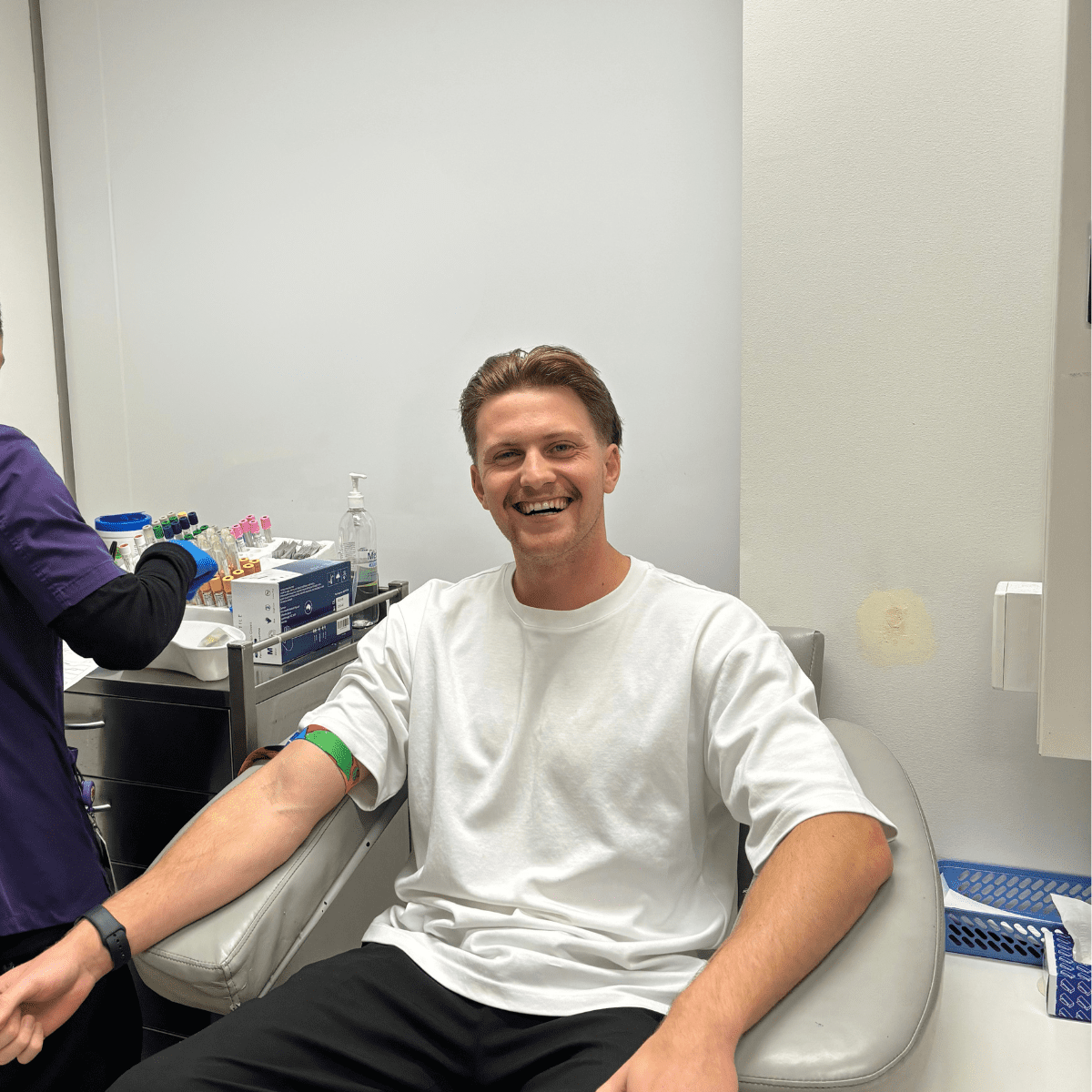
One quick blood draw. Take your pathology form to any partner collection centre, no appointment needed, and the collector does the rest.
Your result is sent privately to your email. It is never linked to Medicare or My Health Record, and nobody is notified unless you choose to share it.
If you would rather not have a blood test at all, the myDNA Methylation Report is a cheek swab you collect at home. It reads both MTHFR variants plus ten other methylation genes.
Why do people get an MTHFR gene test?
Most people get one because they want to understand their own biology, not because of a single event. These are the situations that come up most.
- You want to know how you process folate. Your MTHFR result shows how your pathway is set up, which is useful context for anyone who takes an interest in their B vitamins and diet.
- You are planning a family. Folate matters before and during pregnancy, and many people want their MTHFR result in hand to talk through with their GP or midwife.
- You are already looking at your levels. If you check homocysteine, vitamin B12 or folate, the gene result explains part of the picture behind those numbers.
- A practitioner suggested it. Naturopaths, dietitians and other practitioners often ask about MTHFR status, and a written result is easier to work with than a guess.
- You are building your genetic picture. Alongside tests such as ApoE or a wider methylation report, MTHFR is one piece of a bigger map of how you are built.
- You want one answer you only need once. Your DNA does not change, so this is a test you do a single time and keep for life.
Want to know which MTHFR variants you carry?
Get the MTHFR TestHow do you read and use your result?

Your report lists the two variants and, for each one, how many copies you carry: none, one or two. There is no good or bad result. It is a record of how your methylation pathway is set up, and it reads the same way whether you got it at 25 or 55.
| Your result | What it means |
|---|---|
| No variants | Your MTHFR enzyme is built to work at typical efficiency. Around one in six people get this result. |
| One copy of C677T or A1298C | The most common result. The enzyme may run slightly less efficiently, which for most people makes little practical difference. |
| Two copies, or one of each | The enzyme is likely to run less efficiently, so folate and homocysteine levels are worth looking at alongside the gene result. |
Three steps make the result useful:
- Pair it with your levels. Homocysteine, vitamin B12 and folate show how your methylation is running right now. The Methylation Profile measures all three with your MTHFR genotype in one blood draw.
- Take it to a health professional. A GP, dietitian or pharmacist can read it alongside your health history, your diet and any supplements you take. Your result is not a reason to change supplements on your own, and Australian guidance recommends the standard folate supplement before and during pregnancy whatever your MTHFR status (RACGP, Tasmanian Clinical Genetics Service).
- Keep the report. Your genes stay the same, so there is nothing to retest. Store the PDF with your other results and refer back to it whenever you review your bloods.
MTHFR Test or a methylation test?
Four MediTests tests relate to MTHFR or methylation. They look at different things, and the right one depends on the question you are asking.
| Test | What it looks at | Best if you want |
|---|---|---|
| MTHFR Test | The C677T and A1298C variants, from a blood sample | A clear answer to "which MTHFR variants do I carry?" |
| Methylation Profile | MTHFR genotype plus homocysteine, vitamin B12 and folate, from the same blood sample | The gene result and your current levels together |
| myDNA Methylation Report | 12 methylation genes including both MTHFR variants, from a cheek swab at home | A wider genetic picture with no blood test |
| Genetic Methylation Test | SAMe, SAH, the SAM/SAH ratio and folate forms, which are markers rather than gene variants | To measure how methylation is functioning right now |
The simplest way to see the difference: the MTHFR Test reads a gene that does not change, while the Methylation Profile also measures levels that do. Many people start with the gene result and add the levels later, or get both at once.
What are the limitations?
Australian guidance does not recommend MTHFR testing for everyone, because the variants are so common and, for most people, have little effect on day-to-day health (RACGP, VCGS). That is why a GP may not arrange one and why it is a self-funded test. It does not stop you from choosing to know your own genes, it just means a result is best read as information rather than a diagnosis.
A gene result shows how your pathway is set up, not how it is working today. A 2016 review in Australian Family Physician notes that measuring homocysteine can give more useful day-to-day information than the genotype alone (Australian Family Physician), which is exactly why the Methylation Profile puts the two together.
Tests mentioned in this article
MTHFR Test
The C677T and A1298C variants from one blood sample at a collection centre. No referral, results in 24 to 48 hours.
Methylation Profile
MTHFR genotype, homocysteine, vitamin B12 and folate from the same blood draw.
myDNA Methylation Report
12 methylation genes, including both MTHFR variants, from a cheek swab collected at home.
Genetic Methylation Test
SAMe, SAH, the SAM/SAH ratio and folate forms, to measure how methylation is functioning now.
See every option on our DNA and genetic tests page.
Frequently asked questions
An MTHFR gene test is a blood test that checks which of the two common MTHFR variants, C677T and A1298C, you carry. The MTHFR gene makes an enzyme that helps your body process folate and homocysteine, and the variants can change how efficiently that enzyme works.
The MediTests MTHFR Test checks the C677T and A1298C variants from one blood sample given at a collection centre. It reads your genes, so it does not measure current homocysteine, vitamin B12 or folate levels. The Methylation Profile adds those to the same blood draw.
You can get the MediTests MTHFR Test without a GP referral or appointment. Choose the test, get your instant pathology form and walk into any of 3,300+ collection centres across Australia. Your GP or another health professional can talk the result through with you if you wish.
The two terms describe the same thing when it comes to C677T and A1298C. People often search for an MTHFR mutation, but Australian genetics services prefer the words variant or polymorphism because these changes are very common and are found in healthy people.
Very common. The Tasmanian Clinical Genetics Service reports that 48% of people carry one MTHFR variant, 36% carry two and 16% carry none, so most Australians carry at least one.
Results for the MediTests MTHFR Test are sent privately to your email within 24 to 48 hours of your blood sample being collected, in the same pathology report format used by hospitals and GPs.
The test reads your DNA, which stays the same for life, so you only ever need it once. Levels such as homocysteine, vitamin B12 and folate can change over time, and the Methylation Profile measures those if you want to track them.
An MTHFR test reads the variants of one gene and tells you how your methylation pathway is set up. A methylation test, such as the Genetic Methylation Test, measures markers such as SAMe, SAH and folate forms to show how methylation is working right now. They answer different questions and many people do both.
- RACGP. First Do No Harm: MTHFR gene testing, patient resource (revised 1 November 2022). racgp.org.au
- RACGP. First Do No Harm: MTHFR gene testing, GP resource (revised 1 November 2022). racgp.org.au
- Victorian Clinical Genetics Services. Fact sheet CSF-014: MTHFR (27 October 2021). vcgs.org.au
- Tasmanian Clinical Genetics Service. MTHFR information sheet (last updated February 2019). health.tas.gov.au
- Long S, Goldblatt J. MTHFR genetic testing: controversy and clinical implications. Australian Family Physician, April 2016. racgp.org.au
Reviewed by the MediTests Medical Team. This article is general information, not personalised medical advice. Always discuss your results with a doctor.
Find out which MTHFR variants you carry
One blood sample at any of 3,300+ collection centres, results in 24 to 48 hours. No GP referral needed.
Get the MTHFR Test