
What Is a Methylation Test? Methylation vs MTHFR Testing, Explained
"Methylation test" can mean three very different things. Here is what each one measures, how a methylation test differs from an MTHFR test, and how to pick the right one, with no GP referral.
- Methylation is a chemical process your body runs billions of times a day, using folate and vitamin B12 to pass tiny "methyl groups" from one molecule to another.
- "Methylation test" can mean three things: the levels of methylation markers, variants in a gene such as MTHFR, or an epigenetic age estimate. They answer different questions.
- An MTHFR test reads one gene, so the result never changes. A methylation marker test measures levels that can move over time, which makes it the one worth repeating.
- MediTests offers four methylation tests, from a two-variant MTHFR check to a 12-gene cheek swab, with no GP referral. None of them is a diagnosis.
What is a methylation test?
A methylation test is any test that looks at methylation, a chemical process your body relies on for everything from building DNA to recycling an amino acid called homocysteine. Folate and vitamin B12 are the main nutrients that keep it running (Pathology Tests Explained).
The catch is that the phrase gets used for very different tests. Some measure the chemistry itself, the levels of markers in your body. Some read the genes that set that chemistry up. And some read methylation marks on your DNA to estimate how old your cells "look". If you have searched for a methylation test and found a blood test, a gene test and a biological age test all answering to the same name, that is why.
This guide sorts them out: what each type measures, how a methylation marker test differs from an MTHFR gene test, why people get tested, what the results can show you and which test fits the question you are actually asking.
Methylation in 60 seconds
Picture a relay. A methyl group, one carbon atom with three hydrogens attached, gets handed from molecule to molecule. Folate and B12 pass it to homocysteine, which turns into methionine. Methionine becomes SAMe, the body's main methyl donor, which hands the group on to wherever it is needed: DNA, hormones, neurotransmitters, cell membranes. What is left behind is SAH, which is broken down back into homocysteine, and the loop starts again.
The methylation cycle in one line. A marker test measures the levels at these points. A gene test reads the instructions for the enzymes that run them, such as MTHFR.
Every "methylation test" plugs into this loop somewhere. That is the key to telling them apart.
The three things people mean by "methylation test"
There are three groups of tests that get called methylation tests. Each one looks at a different layer of the same process.
1. Methylation markers: the levels themselves
These measure the substances moving through the cycle, so they show how your methylation is running at the time you give the sample. The Genetic Methylation Test is the most detailed version MediTests offers. It measures SAMe, SAH, the SAM/SAH ratio and three forms of folate (THF, 5-formyl THF and 5-MTHF), so you see the methyl donor, the by-product and the folate that feeds them side by side. It comes as an at-home kit, posted to your door with a prepaid return.
Despite the word "genetic" in its name, this test does not read gene variants. It measures markers, and markers can change, which is exactly what makes them useful to track.
Homocysteine, vitamin B12 and folate sit in the same group. They are measured in a standard blood sample, and the Methylation Profile puts all three in one report alongside your MTHFR genotype, so you get a gene result and the levels it influences together.
2. Variants in your methylation genes
A gene test reads the code you were born with. MTHFR is the best-known methylation gene, and the MTHFR Test reads its two common variants, C677T and A1298C, from a blood sample at a collection centre.
MTHFR is one gene among many, though. The myDNA Methylation Report reads 12 methylation-related genes from a cheek swab you collect at home, including MTHFR, MTR, MTRR, MTHFD1, CBS, COMT, PEMT, FUT2 and TCN2, which between them cover how you handle folate, B12, B6, choline and homocysteine. Your genes do not change, so a gene test is something you only ever need to do once.
3. Methylation marks on your DNA
This is the research end of the spectrum. Methyl groups also attach to DNA itself and help switch genes on and off, and the pattern of those marks shifts with age. Tests that read the pattern to estimate biological age are called epigenetic clocks (Frontiers in Molecular Biosciences). They are a different tool for a different purpose, and we come back to them further down.

At home or at a centre, depending on the test. The Genetic Methylation Kit and the myDNA swab are collected at home and posted back. The Methylation Profile and MTHFR Test are a quick blood draw at any collection centre.
Every MediTests methylation test comes with no GP referral, no appointment and results sent privately to you.
Methylation test vs MTHFR test: what is the difference?
The difference in one sentence: an MTHFR test looks at one gene, while a methylation marker test looks at levels across the methylation cycle. Here is how that plays out in practice.
| Methylation marker test | MTHFR gene test | |
|---|---|---|
| What it looks at | Levels of markers such as SAMe, SAH, folate forms, homocysteine and B12 | The C677T and A1298C variants of one gene |
| Sample | At-home kit (Genetic Methylation Kit) or blood at a centre (Methylation Profile) | Blood at a centre, or a cheek swab at home for the 12-gene myDNA report |
| Can the result change? | Yes. Levels move with diet, supplements and other factors | No. A gene variant stays the same for life |
| Best used to | See how methylation is running now, set a baseline and track it | Find out which variants you carry, once |
| Worth repeating? | Yes, that is the point of it | No, one test is enough |
| MediTests tests | Genetic Methylation Test, Methylation Profile | MTHFR Test, myDNA Methylation Report |
They are not either-or. A gene result tells you how your methylation is set up; a marker result tells you how it is going. Plenty of people start with one and add the other later, and the Methylation Profile gives you a bit of both in a single blood draw.
If you want the full picture on the gene side, our MTHFR gene test guide covers what the variants mean, how common they are and who the test is for.
Ready to see your own numbers?
Get The Genetic Methylation KitWhat a methylation test can show you
A methylation report puts each marker next to the laboratory's reference range, so the first thing you see is where you sit. Depending on the test, that means you can see:
- Whether your methyl donor and its by-product are in balance. The SAM/SAH ratio compares the two in one number, which is why it is the line most people track between tests.
- How your folate is made up. Three forms reported separately, rather than one folate number, so you can see which form is doing the work.
- Where homocysteine, B12 and folate sit. The three everyday markers of the cycle, all reported against reference ranges in the same blood sample.
- Which MTHFR variants you carry, if your test reads genes, and with the 12-gene report, how the rest of your methylation pathway is set up too.
- A baseline worth keeping. Marker results are a snapshot, and the second snapshot is where they start to tell a story.
A result shows what was measured. It does not show what caused it, so it works best as one piece of a bigger picture that you and a health professional put together.
Why people get a methylation test
Most people who get tested simply want information they cannot get any other way. These are the situations that come up most often.
Wanting a baseline. A first result gives you a starting point, which is especially useful before you change your diet or supplements so you have something to compare against afterwards.
Taking folate or B12 and wanting to see the numbers. If you already supplement, a marker test shows whether those levels, and the markers downstream of them, sit where you expect.
A relative has an MTHFR variant. Variants run in families, and a gene test tells you where you stand. Pairing it with markers shows whether it is making any difference to your levels.
Wanting something specific to talk through. A report gives a GP, dietitian or naturopath actual numbers to work with, rather than a conversation about methylation in the abstract.
Curiosity, plainly. If you have read about methylation online and want to know what is measurable and what is just talked about, a test is the quickest way to find out.
Which methylation test suits you?
The right test depends on the question you are asking. Here are the four MediTests options side by side.
| Test | What it reads | Sample | Choose it if |
|---|---|---|---|
| Genetic Methylation Test | SAMe, SAH, the SAM/SAH ratio and three folate forms | At-home kit | You want the most detailed snapshot of how your methylation is running right now, and something to track over time |
| Methylation Profile | MTHFR genotype, homocysteine, vitamin B12 and folate | Blood, at a collection centre | You want a gene result and the everyday markers in one report, with results in 24 to 48 hours |
| MTHFR Test | The C677T and A1298C variants | Blood, at a collection centre | You only want to know which MTHFR variants you carry, once |
| myDNA Methylation Report | 12 methylation genes, including MTHFR | Cheek swab, at home | You want the whole methylation pathway mapped, no needles, with a personalised report |
See the report before you buy. The Genetic Methylation Kit comes back as a laboratory report with every marker, your result and the reference range. Preview a sample report.
Two tests, two questions? Start with the one that matters most to you now. You can always add the other.
And if you have a specific health concern, talk to your GP first. A test is a good companion to that conversation, not a substitute for it.
How to get a methylation test in Australia
No referral, no appointment, no explaining why you want it. The process is the same for every MediTests test, with one small difference for at-home kits.

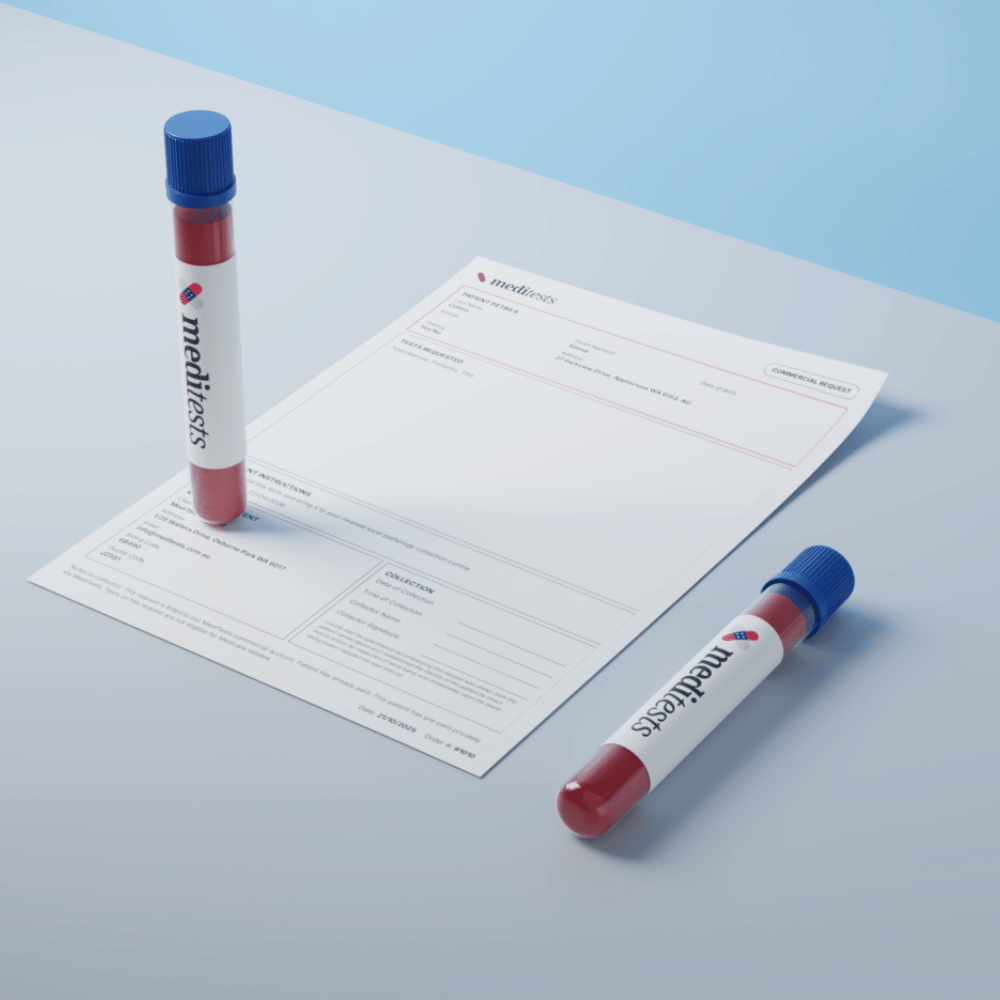
Results come straight to you, in the laboratory's report format, with anything outside the reference range flagged. Find your nearest centre on the collection centres page.

At-home kits. The Genetic Methylation Kit and the myDNA Methylation Report both arrive in plain packaging with everything you need and a prepaid return. Collect your sample at home in a few minutes and post it back.
Your results are confidential and never linked to Medicare or My Health Record.
How to read your methylation report
A marker report lists each marker, your result and the laboratory's reference range. A gene report lists the variants it looked at and how many copies of each you carry. Here is what the main lines mean.
| On your report | What it is | What to look for |
|---|---|---|
| SAMe | The body's main methyl donor | Where it sits against the reference range |
| SAH | What is left after SAMe hands its methyl group on | Read alongside SAMe rather than on its own |
| SAM/SAH ratio | The balance between the two | The single number most people track between tests |
| Folate forms | THF, 5-formyl THF and 5-MTHF, three versions of the same vitamin | How the forms compare with each other and with the range |
| Homocysteine | An amino acid the cycle recycles using B12, folate and B6 | Whether it sits inside the laboratory range |
| Vitamin B12 and folate | The nutrients that feed the cycle | Levels against the range, and whether they match what you take |
| MTHFR C677T and A1298C | The two common variants of the MTHFR gene | Whether you carry zero, one or two copies of each |
A few habits make any report easier to use:
- Go marker by marker. Each line answers a narrow question, so resist reading the whole report as one verdict.
- Note what sits inside its range. A result in range is useful information too, especially as a baseline.
- Keep gene results and levels separate in your head. A variant never changes, a level can, so they tell you different things.
- Keep the report. It is the thing your next result gets compared with.
Getting the most from a repeat test
The value of a baseline comes from what you compare it with. A few simple choices keep a repeat test comparable:
- Use the same test. The same markers and the same laboratory method make for a like-for-like comparison.
- Follow the collection instructions each time. The product page and your pathology form cover what to do before you give your sample.
- Keep a short note of what changed between tests, such as new supplements or a change to your routine, so the numbers have context.
- Tell your health professional what you take. Supplements and medicines can shape several of these markers, and they can read the result with that in mind.
Gene tests do not need repeating. Your DNA stays the same, so a single MTHFR or myDNA result is yours for life. Only the marker tests are worth comparing over time.
Not the same thing: DNA methylation and biological age
Some tests read methylation marks across your DNA to estimate biological age. These epigenetic clocks measure methylation at specific sites in the genome and are a genuinely interesting area of research, though the same review notes that how well they generalise across different populations is still being worked out (Frontiers in Molecular Biosciences).
That is a different test with a different purpose. The MediTests Biological Age test measures telomere length, which is a separate marker of cellular ageing, and neither one is the same as a methylation marker test or an MTHFR test. If a test calls itself a DNA methylation test, check what it actually reports: an age estimate, a set of genes or a set of markers are three different things.
A few things to keep in mind
A methylation test measures and tracks. It does not diagnose a condition, and no single result should be read as a verdict on your health.
On the gene side, Australian guidance does not recommend MTHFR testing as a routine screen, because the variants are so common that a result on its own rarely changes what a GP would advise (RACGP, VCGS). That is worth knowing before you test, and it is also why the marker tests, which show what is actually happening, are the ones most people find more useful over time.
Either way, results are best read alongside your health history, your diet and anything you take, with a health professional who knows you.
Tests mentioned in this guide
Genetic Methylation Test
SAMe, SAH, the SAM/SAH ratio and three folate forms. The most detailed methylation snapshot, collected at home.
Methylation Profile
MTHFR genotype, homocysteine, vitamin B12 and folate in one blood test, results in 24 to 48 hours.
MTHFR Test
The C677T and A1298C variants, from a blood sample at any collection centre.
myDNA Methylation Report
12 methylation genes from a cheek swab at home, with a personalised report.
Biological Age
Telomere length, a marker of cellular ageing, from an at-home kit.
See the full range on our DNA and genetic tests page.
Frequently asked questions
A methylation test is a general name for a few different tests. It can mean a blood test that measures markers in the methylation cycle, such as SAMe, SAH, homocysteine, folate and vitamin B12, a gene test that reads variants such as MTHFR, or a research-style test that estimates biological age from methylation marks on your DNA. The MediTests Genetic Methylation Test is the first kind: it measures markers rather than gene variants.
That depends on which test you choose. The Genetic Methylation Test measures SAMe, SAH, the SAM/SAH ratio and three forms of folate. The Methylation Profile measures homocysteine, vitamin B12 and folate and adds your MTHFR genotype. The MTHFR Test reads the two common MTHFR variants, and the myDNA Methylation Report reads 12 methylation genes from a cheek swab.
They answer different questions. An MTHFR test reads the variants of one gene, and that result never changes. A methylation marker test measures levels in your body that can move over time with diet, supplements and other factors. MediTests offers both, including the MTHFR Test, with no GP referral needed.
Only the tests that read genes do. The Genetic Methylation Test measures markers and does not look at your DNA. The Methylation Profile includes your MTHFR genotype alongside homocysteine, B12 and folate, and the MTHFR Test reads the C677T and A1298C variants directly. Our MTHFR gene test guide explains what those variants mean.
Choose by the question you want answered. If you want to see how your methylation is running right now, start with a marker test such as the Genetic Methylation Kit, which is collected at home. If you want to know how your genes are set up, which never changes, a one-off gene test is enough, and the myDNA Methylation Report does that from a cheek swab. Many people do one of each over time.
With MediTests you do not need a GP referral or an appointment. At-home kits such as the Genetic Methylation Kit are posted to your door with a prepaid return. For blood tests, your instant pathology form arrives in your inbox, ready to take to any of 3,300+ collection centres.
Blood tests collected at a collection centre, such as the Methylation Profile and the MTHFR Test, are usually back within 24 to 48 hours. Genetic reports and specialist methylation markers take longer because the laboratory work is more involved, and each product page shows the timing for that test.
Not usually. Some biological age tests estimate your age from methylation marks on your DNA, which researchers call epigenetic clocks. The MediTests Biological Age test measures telomere length instead, which is a different marker of cellular ageing. Neither is the same as a methylation marker test or an MTHFR gene test.
A methylation test measures and tracks markers or gene variants. It does not diagnose anything on its own, and your results make the most sense when a GP, dietitian or other health professional reads them alongside your health history and any supplements you take.
- Pathology Tests Explained. Homocysteine. ptex.au
- Pathology Tests Explained. Folate. ptex.au
- RACGP. First Do No Harm: MTHFR gene testing, patient resource (revised 1 November 2022). racgp.org.au
- Victorian Clinical Genetics Services. Fact sheet CSF-014: MTHFR (27 October 2021). vcgs.org.au
- Chen Y, Cheng X, Ji S. DNA methylation and prediction of biological age. Frontiers in Molecular Biosciences, January 2026. frontiersin.org
- MediTests. Genetic Methylation Test, Methylation Profile, MTHFR Test and myDNA Methylation Report product pages (accessed October 2026). meditests.com.au
Reviewed by the MediTests Medical Team. This article is general information, not personalised medical advice. Discuss any result with your GP or another health professional.
Measure your methylation, your way
SAMe, SAH, the SAM/SAH ratio and three folate forms in one at-home kit. No GP referral, results sent privately to you.
Get The Genetic Methylation Kit